
Water tank manufacturing
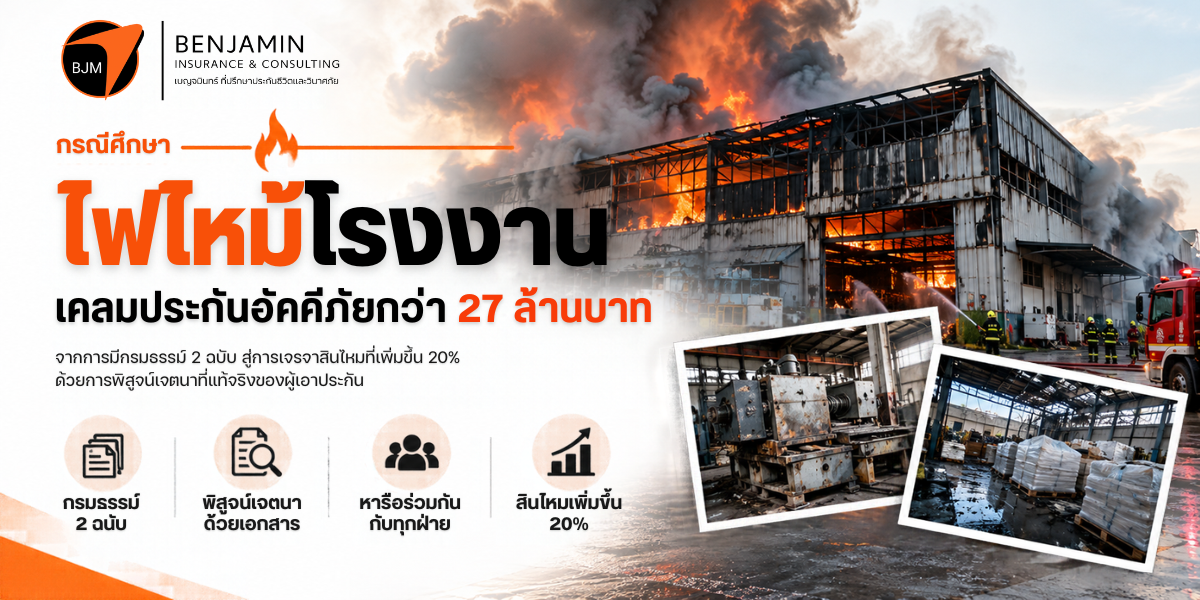
Underinsured Fire Claim with Two Policies: How a Factory Recovered an Extra THB 1.37 Million
📋 Situation
Toward the end of 2025, a fire struck a water tank factory, damaging buildings, machinery, furniture and stock. The total claim exceeded THB 27 million. The factory held two fire insurance policies with different insurers, taken out at different times as the plant expanded. After the fire, the original agent did not step in to support or advise on the claim. When the assessment came back at odds with what the client had intended to insure, a long-standing Benjamin client referred them to us, and we took on the claim as their consultant.
⚠️ The Challenge
The fire caused around THB 27.5 million in actual damage, but the factory was underinsured. When the sum insured falls short of the true value, insurers pay only in proportion to the cover, under the average clause.
Two policies should have strengthened the client’s cover. Instead, the first assessment used them to cut the payout further.
The adjuster treated both policies as jointly covering the whole factory. It measured the combined value of all three buildings, about THB 18.8 million, against the second policy’s building sum insured of just THB 5 million. That put adequacy at 26.58%, even though this policy was only ever meant to cover the two new buildings. The old building was almost fully insured (91%) under the first policy. Yet it was split with the second policy instead of being paid in full. The initial assessment came to only THB 6.76 million.
The client was left to handle a multi-million-baht claim alone, with no one to explain the assessment or argue their case.
🛠 What Benjamin Did
We reframed the question from “are the numbers right?” to “what did the insured intend to insure?”, under the principle of utmost good faith.
- We drafted a statement of intent, signed by the company’s authorised director. It set out which buildings and assets fell under each policy and confirmed there was no double insurance.
- We submitted the 2020 extension drawings and site photos as evidence that the new buildings were built later and insured under the second policy.
- We proposed a joint meeting of all parties to settle the dispute, rather than arguing line by line.
- In parallel, we worked with the client’s team to re-check quantities and prices. This surfaced missed items such as cranes, small machinery and the actual exchange rate on imported equipment.
- When the adjuster issued a split-policy schedule, we confirmed the intent in writing and accepted promptly to close the claim.
✅ Results
The net settlement rose from THB 6,758,865.50 to THB 8,126,821.95, an increase of THB 1,367,956.45 or about 20%. More than 87% of the gain came from buildings, as a direct result of splitting the policies. The rest came from newly identified items. Both insurers agreed to pay their own shares. Negotiation took about eight weeks, and the first payment reached the client in October 2026. The client then chose Benjamin to handle the factory’s new Industrial All Risk insurance for their factory.
💡 Key Learnings
If you hold more than one fire/property policy, state clearly which assets each one covers. Without that, an adjuster may treat the policies as double insurance and apply average and contribution, which can sharply cut the payout. In a dispute, the insured’s genuine intent carries real weight when it is backed by documents: a signed statement from an authorised person, building plans and a construction timeline. The best protection is to define each policy’s locations and buildings at placement, and review them every time the facility expands.
Ready for Benjamin to take care of you?
Let us be your personal risk management team.