
Logistics
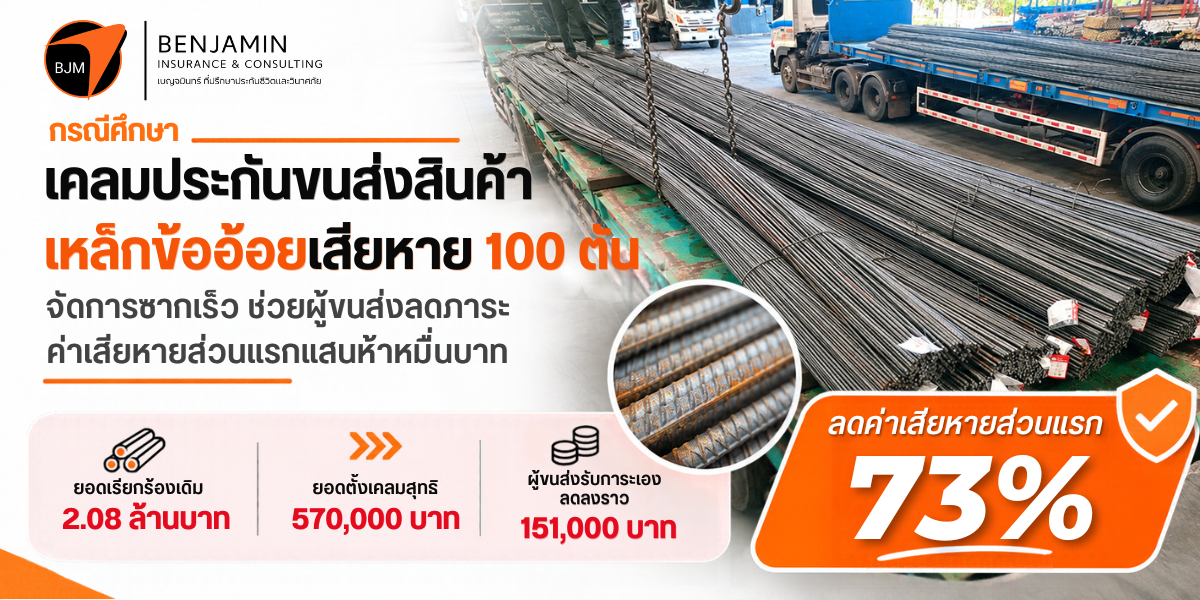
Damaged Rebar Cargo Claim: How Fast Salvage Handling Cut the Carrier’s Deductible by 73%
📋 Situation
Two trucking companies, both cargo insurance clients of Benjamin, delivered more than 11,000 rebar bars, about 100 tonnes, to a consignee. On arrival, surface rust was found on the steel, which meant it could no longer be sold at full price.
The consignee issued damage claim letters to both carriers, totaling about THB 2.08 million.
⚠️ The Challenge
Under both carriers’ policies, the deductible was 10% of the claimed loss, so the higher the claim, the more the carriers had to bear themselves. If the loss stayed at the full value of the goods, the two carriers would have paid about THB 208,000 in deductibles.
The damaged steel still had high salvage value, but at 100 tonnes it was a very large lot. Few buyers can take that much quickly, and on the open salvage market the claim risked dragging on over price and pickup schedules.
🛠 What Benjamin Did
Benjamin’s claims team focused on handling the salvage quickly and at a fair value, so the claim reflected the actual loss:
- Sourced a salvage buyer from Benjamin’s network able to take the whole lot over several trips at short notice.
- Arranged for the buyer to purchase the steel directly from the consignee at a price the consignee accepted, so the salvage value was deducted from the loss from the start.
- Kept every party working from the same information: the consignee, the carriers, the salvage buyer and the insurer’s surveyor.
- Built a traceable document trail, linking bar counts, lots and truck trips to every document.
- Filed the claim for the net loss the carriers actually bore, after the salvage value.
✅ Results
The loss used for the claim fell from about THB 2.08 million to about THB 570,000. The outcome:
- Carriers: deductibles fell from about THB 208,000 to about THB 57,000, a reduction of about THB 151,000, or 73%.
- Insurer: paid about THB 38,000 less than with a standard sale of the salvage by weight.
- Consignee: was fully compensated as agreed and did not have to sell the salvage itself.
The claim closed quickly because the salvage value was settled on the day the buyer collected the steel.
💡 Key Learnings
When cargo is damaged in transit but still has value, handling the salvage quickly and at a fair price lets the claim reflect the actual loss. That reduces the burden on both the carrier and the insurer, while the consignee is still fully compensated.
The right time to call a claims advisor is the moment a damage claim letter arrives, before agreeing to any amount or selling the salvage.
Deductible terms and claim outcomes vary by policy and by the facts of each case.
If your truck has just had an incident, or you have received a damage claim letter, talk to Benjamin’s claims team.
Ready for Benjamin to take care of you?
Let us be your personal risk management team.