
Essential Insurance for Warehouses in Thailand: What Owners, Tenants and Logistics Providers Need
The Short Answer
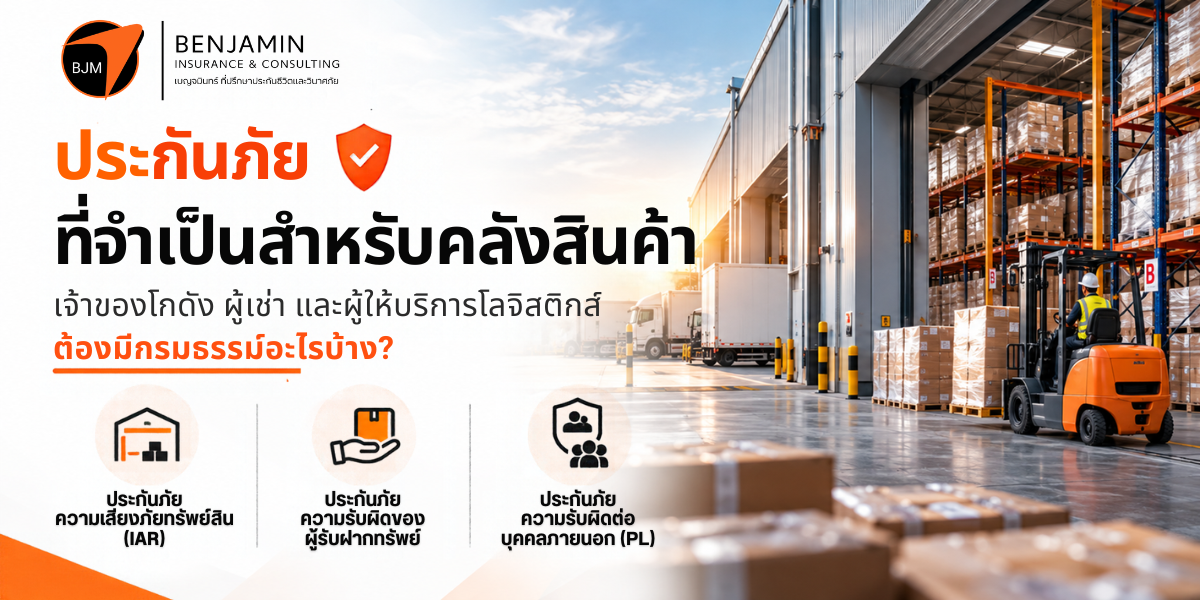
A warehouse or logistics business that stores goods for others typically needs to consider three policies. Each does a different job, and none replaces the others.
- Industrial All Risks (IAR) covers the stock itself, including customers' goods held in your care, against external perils such as fire, flood and electrical short circuits.
- Bailee's Liability covers your liability for customers' goods damaged by operational mistakes, such as a forklift hitting a stack or goods dropped during handling.
- Public Liability (PL) covers your liability to third parties, such as fire spreading to a neighbouring property or a visitor injured on site.
Whether you need all three depends on one question: do you own the warehouse, lease it, or manage operations on someone else's site?
Who This Guide Is For
This guide is written for any business in Thailand that holds goods belonging to others, including third-party logistics (3PL) providers, distribution and fulfilment centres, warehouse lessors who also handle stock, contract warehouse operators working at client sites, and Free Zone or bonded warehouse operators. It is particularly relevant to international logistics groups operating in Thailand's Eastern Economic Corridor, where many operators run a mix of leased and client-managed sites.
The Main Risks in Warehousing
- External perils: fire, electrical short circuits, flood, storm, earthquake, burst pipes
- Theft: particularly forcible break-ins
- Operational accidents: forklift collisions, goods dropped during lifting, improper stacking
- Third-party liability: fire spreading to neighbours, visitors or delivery drivers injured on site
- Contractual liability to depositors: many storage contracts set a fixed compensation limit per occurrence. This figure is the single most important input when setting your insurance limits.
Under the Thai Civil and Commercial Code provisions on deposit, a professional depositary paid for its services is held to a higher standard of care than an ordinary person, so a warehouse operator's exposure for customers' goods is often greater than expected.
Policy 1: Industrial All Risks (IAR)
IAR covers stock whether it belongs to you or is held on behalf of customers (Stock Held in Trust and/or on Commission) against sudden, accidental external perils: fire, lightning, explosion, electrical damage, flood, storm, earthquake, water leakage and theft involving forcible entry (subject to policy terms). If you own the building, the same policy can also cover the structure, racking, machinery and equipment.
A common gap: many operators hold a property policy that only covers their own assets. If goods held in trust are not specified, customers' stock may not be covered when a loss occurs.
Policy 2: Bailee's Liability
Where IAR handles external perils, Bailee's Liability fills the gap for operational negligence by your own staff: forklift impacts, goods dropped during loading and moving, and damage from improper storage.
Key advantage: one Bailee's Liability policy can list multiple insured locations, covering your own warehouses and every client site you manage under a single set of terms. This is simpler to administer and usually more cost-efficient. The limit should be aligned with the compensation you owe customers under your storage contracts.
Policy 3: Public Liability (PL)
PL covers your legal liability for bodily injury, death or property damage to third parties caused by defects in your premises or negligence by you or your staff, including agreed legal costs.
The critical point: PL does not cover customers' goods stored in your warehouse. Property in your care, custody and control is a standard exclusion. A forklift hitting a customer's stock is a Bailee's Liability claim, not a PL claim.
Which Policy Covers What
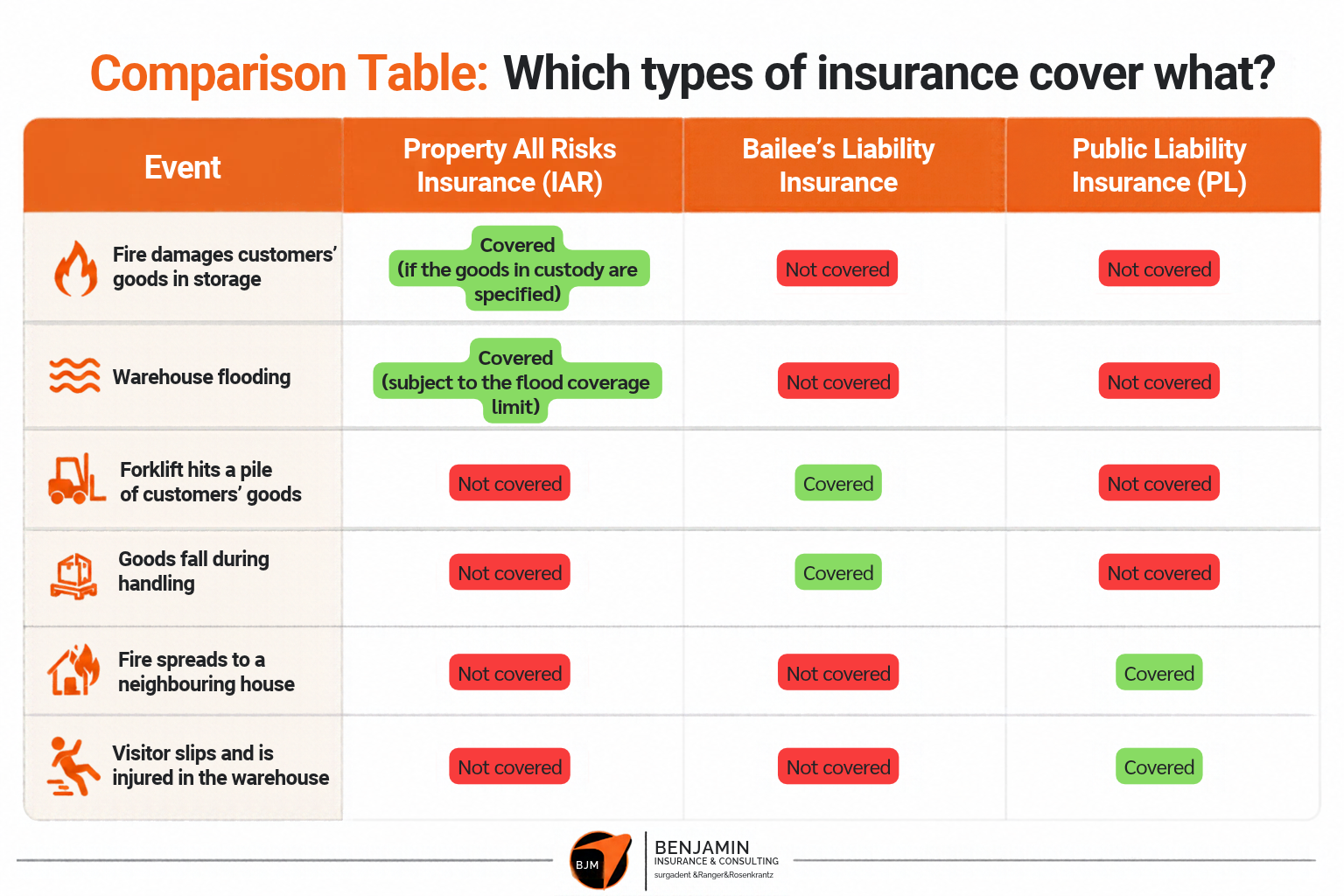
**General guidance only. Actual cover depends on each policy's terms and exclusions.
Structuring Cover by How You Use the Site
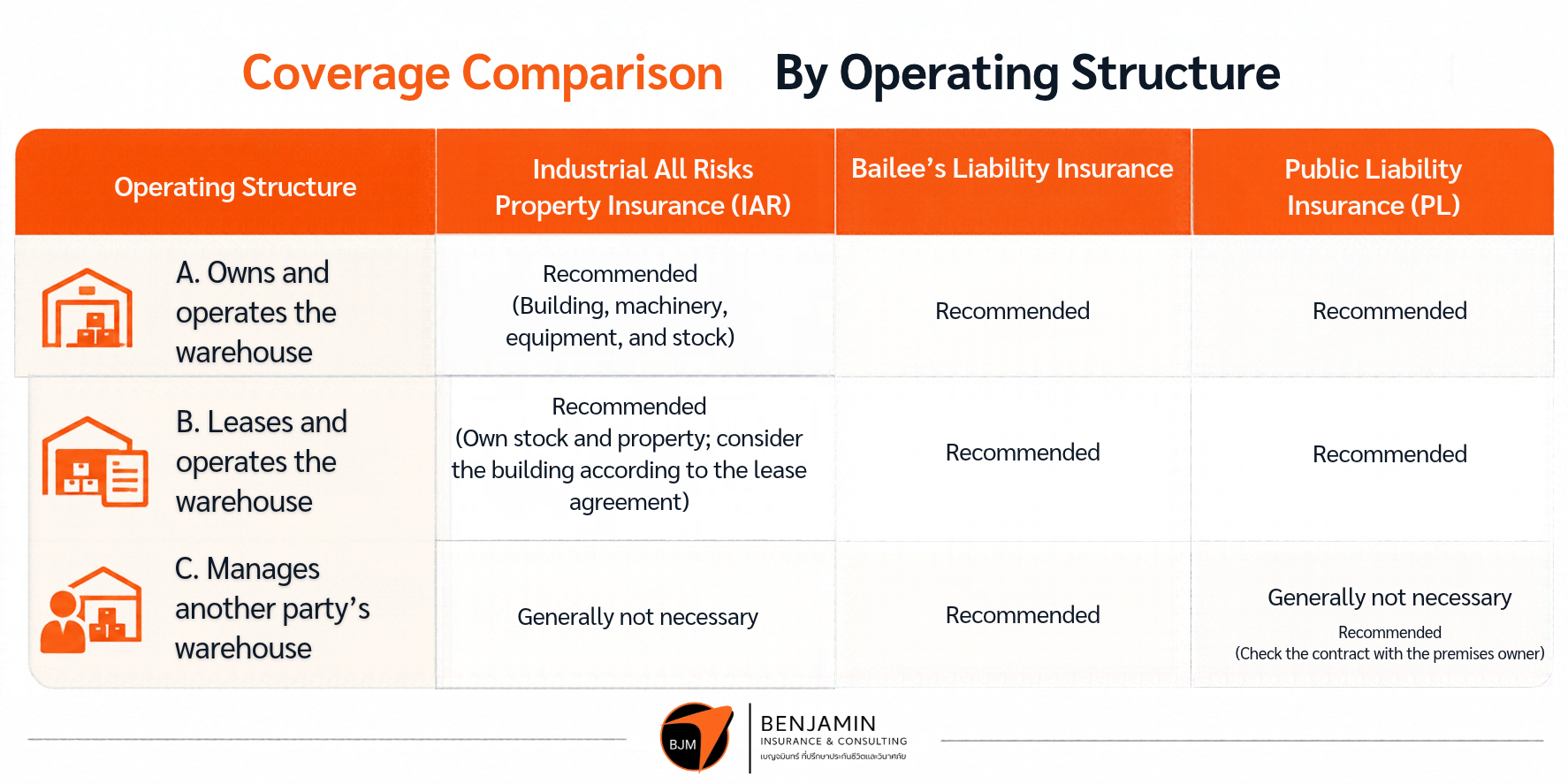
A. Owner-operator: all three policies, with IAR covering building, machinery, equipment and all stock including goods held in trust.
B. Tenant-operator: all three policies, but IAR focuses on stock and the tenant's own assets. Before insuring the building, review the lease to see who is responsible, so you do not pay twice. Key questions:
- Has the landlord already insured the building, and who bears the premium?
- What does the lease say about the tenant's liability for building damage?
- Subrogation: if a fire is caused by the tenant's negligence, the landlord's insurer may pay the landlord and then pursue the tenant. If your rent already includes the building insurance premium, negotiate to be named as a co-insured, or ask the landlord for a Waiver of Subrogation in your favour. This significantly reduces the tenant's legal and financial exposure.
Benjamin reviews the building liability clauses in your warehouse lease free of charge.
C. Contract warehouse manager: usually only Bailee's Liability is needed, since the building and third-party liability at that site belong to the site owner. All managed sites can sit in one policy. Check your management contract for any additional insurance requirements.
Mixed operations: owned or leased sites carry all three policies; client-managed sites are added to the same Bailee's Liability policy.
Common Reasons Warehouse Claims Are Reduced or Declined
From Benjamin's claims experience, most problems come not from having no insurance, but from insurance that does not match the real risk.
- Stock under-insured: stock levels fluctuate. If the sum insured is below the actual value on the day of loss, average may apply and the payout is reduced. Insure at peak stock value or ask about monthly stock declaration options.
- Goods held in trust not specified in the property policy.
- Assuming PL covers customers' goods. It does not.
- Flood and natural catastrophe sub-limits too low, especially for sites in flood-prone areas.
- Unexplained shortages or employee theft: usually outside the theft cover of a property policy. Consider Fidelity Guarantee insurance if this is a material risk.
- Contractual liability higher than the insured limit: the difference comes out of your own pocket.
- BOI or bonded status not checked: duty-exempt goods affect insurable interest and how losses are valued.
What You Need for a Quotation
- Occupancy of each site (owned, leased or client-managed), with location and floor area
- Types of goods stored and maximum stock value at each site
- BOI or bonded warehouse status of goods for every brand stored
- Current contractual compensation limits to depositors (per occurrence or per risk)
- Warehouse lease agreement, if leased, for Benjamin's free review
- List and locations of all client sites you manage
- Main operations, such as forklift use and material handling
- Loss prevention measures: fire suppression and sprinklers, CCTV, security systems
Frequently Asked Questions
Does my warehouse fire policy cover customers' goods? Only if the policy specifically covers goods held in trust. Otherwise it may cover only your own property.
Which policy covers a forklift damaging a customer's goods? Bailee's Liability. Property and Public Liability policies generally do not respond to this type of loss.
Does Public Liability cover goods in my warehouse? No. Property in your care, custody and control is a standard exclusion.
If I lease a warehouse, do I need to insure the building? It depends on the lease. If the landlord already insures the building and recovers the premium through rent, avoid duplicating cover and negotiate a Waiver of Subrogation instead.
I manage warehouses at several client sites. How many policies do I need? All sites can be listed under a single Bailee's Liability policy.
Is flood covered? IAR generally covers flood, often subject to a separate natural catastrophe sub-limit. Check that it is adequate for your stock value.
Why Work With Benjamin
Benjamin Insurance & Consulting has served Thailand's transport and logistics sector for over 30 years and has been insurance advisor to the Northeastern Goods Transport Association for more than 20 years. Our strength is not just placing policies but standing with clients when a loss happens.
- Cover structured around how you actually operate, site by site, with no duplication and no gaps
- Free review of warehouse leases and storage contracts to uncover hidden liabilities
- Hands-on claims support from day one, coordinating with insurers and loss adjusters through to settlement
Talk to Benjamin about warehouse insurance: EMAIL: contact@benjamin.co.th or visit benjamin.co.th.
This article is for general information only and is not an insurance policy or formal quotation. Actual cover depends on the terms and exclusions of each policy.
Ready for Benjamin to take care of you?
Let us be your personal risk management team.