
How to Claim Car Insurance After a Car Accident: A Step-by-Step Guide in Thailand
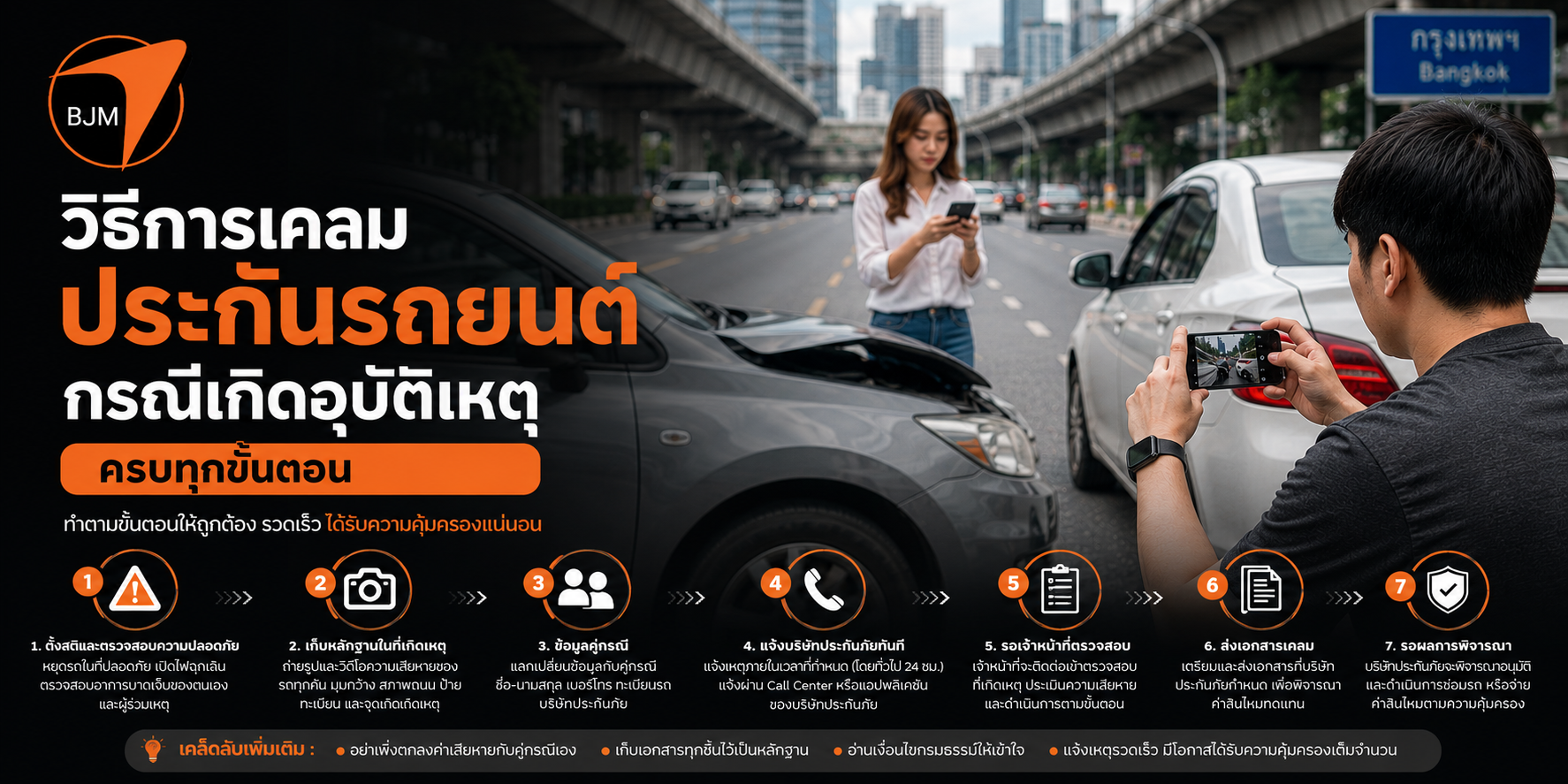
Driving in Thailand comes with a claims process that works differently from what you may be used to back home, and a language barrier can make a stressful moment even harder. When an accident happens, the actions you take in the first few minutes decide whether your claim goes smoothly. This guide explains how to claim car insurance after an accident in Thailand, step by step, with the local details that matter most for foreigners.
Step 1: Stay Calm and Prioritize Safety
Turn on your hazard lights and check for injuries. Keep these numbers saved in your phone before you ever need them:
- 1669 for emergency medical services
- 191 for the police
- 1155 for the Tourist Police, who have English-speaking officers and can help bridge the language gap
For minor incidents where the car is still drivable, move it out of the traffic lane. But if there is a dispute over fault, an injury, or the other driver refuses to cooperate, leave the vehicles where they are until officials arrive.
Step 2: Gather Complete Evidence
Evidence protects you, especially when the other party speaks a language you do not and you cannot follow the verbal discussion. Photograph and film:
- The point of impact and the position of both vehicles before they are moved
- Damage to both vehicles from every angle
- The other party's license plate
- The surroundings, such as traffic lights, signs, and road conditions
- Names and contact details of the other driver and any witnesses
If you have a dashcam, save the footage immediately so it is not overwritten. Do not sign any handwritten document in Thai that you do not fully understand, and never agree to settle in cash at the scene before your insurer is involved.
Step 3: Notify Your Insurer Immediately
Call your insurer's hotline or, better yet, notify your broker, who can speak to the insurer in Thai on your behalf. Have your policy number, license plate, location, and a description of what happened ready. The representative will tell you whether this is a claim with a third party or without one, and will dispatch a surveyor to the scene. Ask whether the hotline has English support, as not all do.
Step 4: Wait for the Surveyor and Get Your Claim Slip
The surveyor inspects the damage and issues your key document on the spot. In a claim involving another vehicle, you receive a claim slip (bai claim) that records who is at fault. In a single-vehicle claim, you receive a damage certificate. Keep this safe, as the repair shop will not proceed without it. Again, do not accept cash or settle privately before notifying your insurer, or you may lose your right to claim.
Step 5: Know Your Thai Insurance Class
Thailand's voluntary motor insurance comes in tiers, and foreigners are often unsure which one they hold. This changes what you can claim:
- Class 1 is the most comprehensive. It covers your own car whether or not there is another party involved, including single-vehicle damage such as hitting a pole or curb. A deductible may apply for at-fault or single-vehicle claims.
- Class 2+ and 3+ only cover damage to your car when another vehicle is involved and identifiable. There is no coverage if you hit a fixed object with no third party.
- Class 3 covers third-party damage only, not your own vehicle.
Separately, every car in Thailand must carry compulsory insurance known as Por Ror Bor (CTPL). This covers bodily injury to people only. It never pays for vehicle damage, which is why voluntary insurance matters.
For a hit and run, file a police report so it can support your claim.
Step 6: Get Your Car Repaired
Take your claim slip and car in for repair according to your policy. A dealer-repair (repair at authorized service center) policy uses the manufacturer's service center, while a garage-repair policy uses the insurer's partner garages. Check which one you have, as it affects both cost and repair quality.
Documents You Will Need
- A copy of your policy or your policy number
- Your driver's license valid in Thailand at the time of the accident (a Thai license, or a valid International Driving Permit together with your home-country license)
- A copy of your passport and the vehicle registration
- The claim slip or damage certificate from the surveyor
- A police report (for hit-and-run cases or disputes)
Note: driving on an expired or invalid license, or on a home-country license alone without an International Driving Permit, can give the insurer grounds to reduce or deny your claim. Confirm your license is valid to drive in Thailand before you get behind the wheel.
Mistakes Foreigners Often Overlook
- Drunk driving voids your own coverage. Under Thailand's OIC regulations, a driver under the influence is not covered for damage to their own vehicle or their own injuries. The insurer still pays third parties, but has the legal right to recover those costs from the driver.
- CTPL is not enough. Por Ror Bor covers people, not cars. Without voluntary insurance, your own vehicle damage is on you.
- License validity is easy to get wrong. Make sure yours is valid to drive in Thailand, as noted above.
- Do not wait too long. The right to claim has a limitation period, so notify and act quickly.
How Benjamin Insurance & Consulting Helps
For foreigners, the hardest part of a claim is rarely the accident itself. It is dealing with insurers, surveyors, and police reports in Thai, and knowing whether the settlement being offered is actually fair.
Benjamin Insurance & Consulting is more than a broker that sells policies. We are a claims consultancy that stands beside our clients from the first minute of an incident. We communicate with insurers in Thai on your behalf, verify that you receive every benefit your policy entitles you to, and negotiate for you when a claim is handled unfairly. For a foreigner navigating an unfamiliar system, that support is the difference between a smooth claim and a frustrating one.
If you want an advisor who guides you from start to finish, in English, contact Benjamin at 02-8935561-2 or through our email at contact@benjamin.co.th
Ready for Benjamin to take care of you?
Let us be your personal risk management team.