
Factory Insurance in Thailand: Fire Insurance vs Property Insurance (IAR) and Public Liability
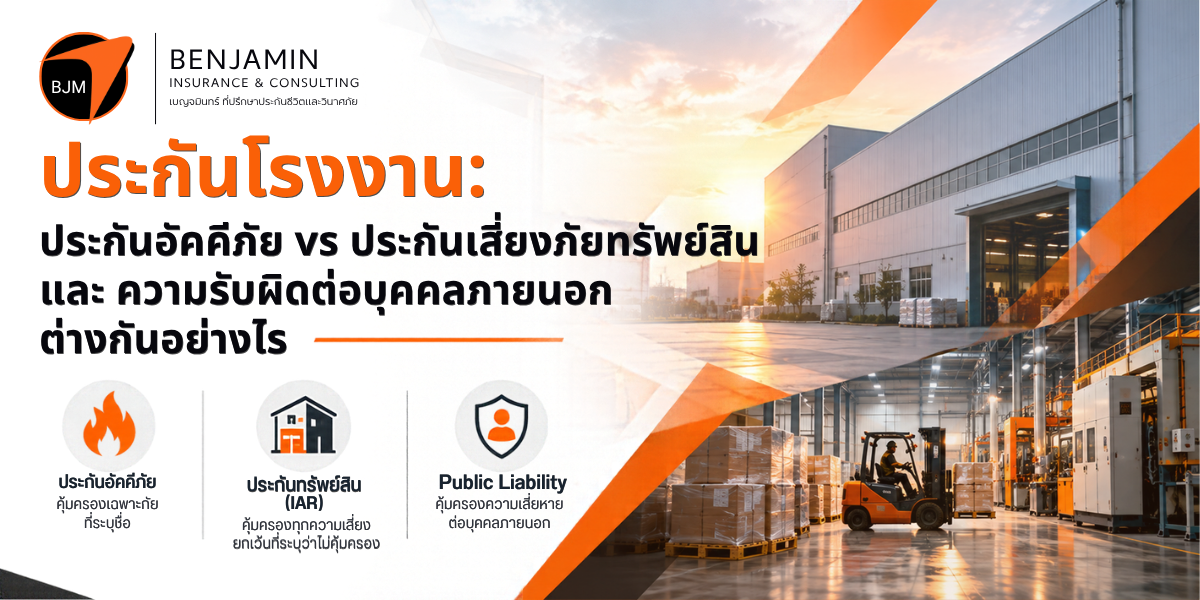
Factory Insurance: Fire Insurance vs Industrial All Risks (IAR) and Public Liability, What’s the Difference?
Which factory insurance actually covers you?
When it comes to factory insurance, most business owners buy “fire insurance” and assume it covers everything. But when something actually happens, such as a break-in theft, a forklift hitting machinery, or a flood in the stock warehouse, many discover the policy does not pay.
The problem is not always the insurer refusing to pay. More often, the policy never matched the real risks from the start. This guide to factory and property insurance explains the difference between fire insurance and Industrial All Risks (IAR), and why factories should also carry Public Liability insurance. It focuses on stock coverage, where claims go wrong most often.
Factory fire insurance: covers only named perils
Fire insurance is a Named Perils policy. It pays only for the perils written in the policy. Anything not listed is not covered.
Core perils under the standard policy
- Fire
- Lightning
- Explosion of gas used for domestic purposes
- Aircraft and articles dropped from aircraft
Optional extensions include windstorm, flood, earthquake, hail, water damage (burst pipes, overflow), smoke, vehicle impact, riot and strike, and malicious damage.
Best for: small factories with simple assets, owners who want a lower premium, or cases where a bank requires coverage for a loan.
Key limitation: general accidents outside the listed perils, such as goods falling and breaking, machinery being hit, or theft, are not covered unless you buy a separate policy.
All Risks property insurance (IAR): covers everything except exclusions
Industrial All Risks (IAR) is an All Risks policy. It works the opposite way to fire insurance: it covers sudden and accidental physical loss or damage from any cause, except those listed in the exclusions.
Beyond fire and natural catastrophes, IAR typically covers events a fire policy will not, such as:
- Theft with forcible entry
- General accidents, such as a forklift hitting racks or goods being dropped
- Water damage, rain ingress or roof leaks from unforeseen events
- Debris removal and architects’ or engineers’ fees for rebuilding (under extensions)
- Damage to machinery from external accidents, such as impact, flood or fire
- Damage to electrical equipment from short circuit or power surge (requires an added extension)
IAR has two sections:
- Material Damage: covers buildings, machinery, equipment and stock
- Business Interruption (optional): compensates lost profit and ongoing fixed costs while the factory cannot operate
Common exclusions include wear and tear, internal mechanical breakdown (requires a separate Machinery Breakdown policy), unexplained shortage or loss found at stocktaking, war, and nuclear risks.
Best for: medium to large factories with high-value machinery, large stock volumes, or owners who want comprehensive cover in a single policy.
Factory property insurance compared: Fire vs IAR
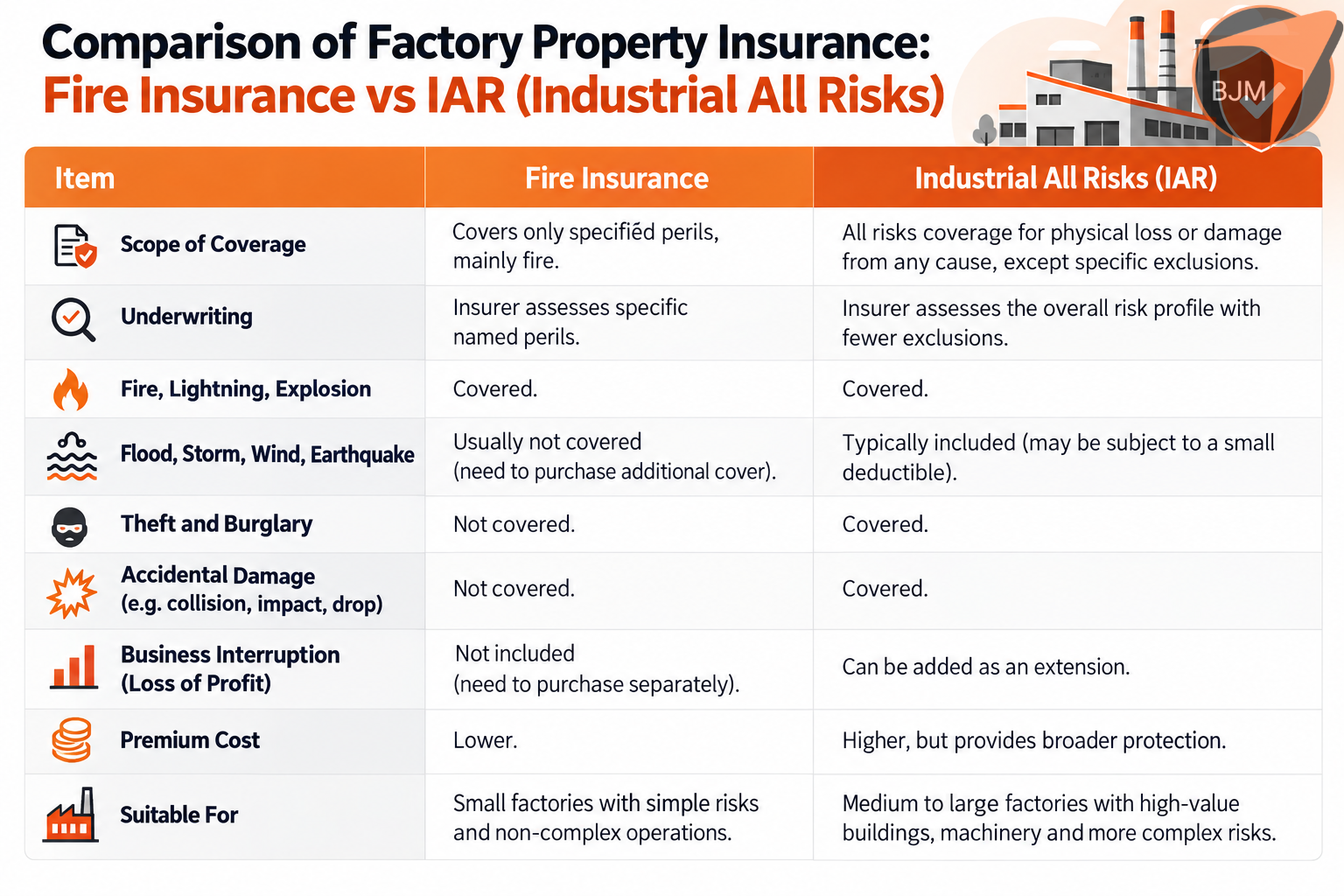
The point most people miss is the burden of proof. Under a named perils policy, the insured must show the loss came from a listed peril. Under IAR, if the insurer wants to decline, it must show which exclusion applies, which makes claims negotiation much easier.
Insuring factory stock: what to specify
Stock changes value every day and is the hardest asset to claim on. Whether you choose fire insurance or IAR, the policy must be set up correctly from the start.
1. List every stock type. Raw materials, work in progress (WIP), finished goods, packaging and spare parts should be clearly stated in the schedule of property.
2. Insure at cost, not selling price. Stock is valued at production or purchase cost. To protect lost profit, buy Business Interruption cover instead.
3. Watch the Average Clause. If the sum insured is lower than the actual value at the time of loss, the insurer pays proportionally. Example: actual stock is THB 20 million, insured for THB 10 million, and a THB 4 million loss may pay only THB 2 million.
4. Seasonal stock fluctuation. Use a monthly Stock Declaration condition, or extend cover for peak periods, instead of insuring the annual peak all year. This saves premium and avoids underinsurance.
5. Stock off-site. Goods in rented warehouses, retail outlets or in transit must be added as insured locations, or covered by a separate cargo policy.
6. Other people’s property in your care. For example, materials a customer sends for OEM production. The policy must include “property in your care, custody and control,” otherwise it cannot be claimed.
7. Temperature-controlled stock. Food, pharmaceuticals or chemicals should have deterioration-of-stock cover for power failure or refrigeration breakdown.
8. Common exclusions. Shortages found at stocktaking without a clear event, employee fraud, and natural deterioration of goods.
Public Liability insurance for factories
Fire insurance and IAR protect the factory’s own property. But if an incident injures third parties or damages their property, the factory is legally liable, and neither policy pays.
Public Liability (or CGL) insurance covers damages the factory is legally liable for arising from its premises or operations, including legal and defense costs.
Examples in a factory setting
- A factory fire spreads to neighboring homes or warehouses
- A contractor, customer or delivery driver slips or is hit by falling goods on site
- A factory sign or roof collapses onto a car parked outside
- A boiler or gas tank explosion damages the surrounding community
Under Thai law, a building owner is liable if defective construction or maintenance causes damage to others (Civil and Commercial Code, Section 434), and anyone in possession of dangerous property such as machinery or chemicals bears heightened liability (Section 437). This risk is very real for factories.
How to make sure your claim succeeds
- Review the sum insured every year, especially after adding production lines or new machinery, to avoid the Average Clause.
- Keep verifiable stock records. ERP data, purchase orders, tax invoices and stocktake reports should be backed up in the cloud or off-site. If records burn with the stock, proving value becomes very difficult.
- Comply with policy warranties such as fire protection systems, sprinklers and flammable storage rules. Non-compliance can void the entire claim.
- Notify the insurer when building use changes, for example from general storage to chemical storage.
- When an incident occurs, notify the insurer immediately, photograph and video the damage before cleaning up, prevent further loss, and never admit liability or agree to compensate a third party before informing the insurer.
Factory insurance FAQ
What insurance does a factory need?
At minimum, property insurance (fire or IAR) covering buildings, machinery and stock, plus Public Liability for damage to third parties. Employees are covered by the Workmen’s Compensation Fund.
How is factory property insurance different from fire insurance?
Fire insurance covers only named perils such as fire and lightning. IAR property insurance covers all accidental damage except what is listed in the exclusions.
Does factory insurance cover stock?
Yes, if stock is declared as insured property and insured at cost. You should also add off-site stock and customer goods held in your care.
How is the factory insurance premium calculated?
It depends on the industry, building construction, fire protection systems, location, sum insured and claims history. Factories with compliant fire protection usually get better rates.
Conclusion
Choosing the right factory insurance starts with understanding that fire insurance pays only for named perils, while IAR property insurance pays for everything except exclusions, and both protect only the factory’s own property. Damage to third parties needs Public Liability to close the gap. For stock, what matters is not just the policy name but a correct sum insured, complete stock types and locations, and well-kept evidence.
Talk to Benjamin Insurance & Consulting
We are an insurance broker and consultant serving business clients since 1993. Our strength is standing with clients at claim time, not just at the point of sale. We review your current factory and property insurance policies for gaps, compare offers from multiple insurers, and manage your claim through to settlement.
Contact us at contact@benjamin.co.th | 0866667290
Ready for Benjamin to take care of you?
Let us be your personal risk management team.