
Why Was My Insurance Claim Not Paid in Full When the Loss Was Below the Sum Insured? Understanding Under-Insurance in Thailand
The Short Answer
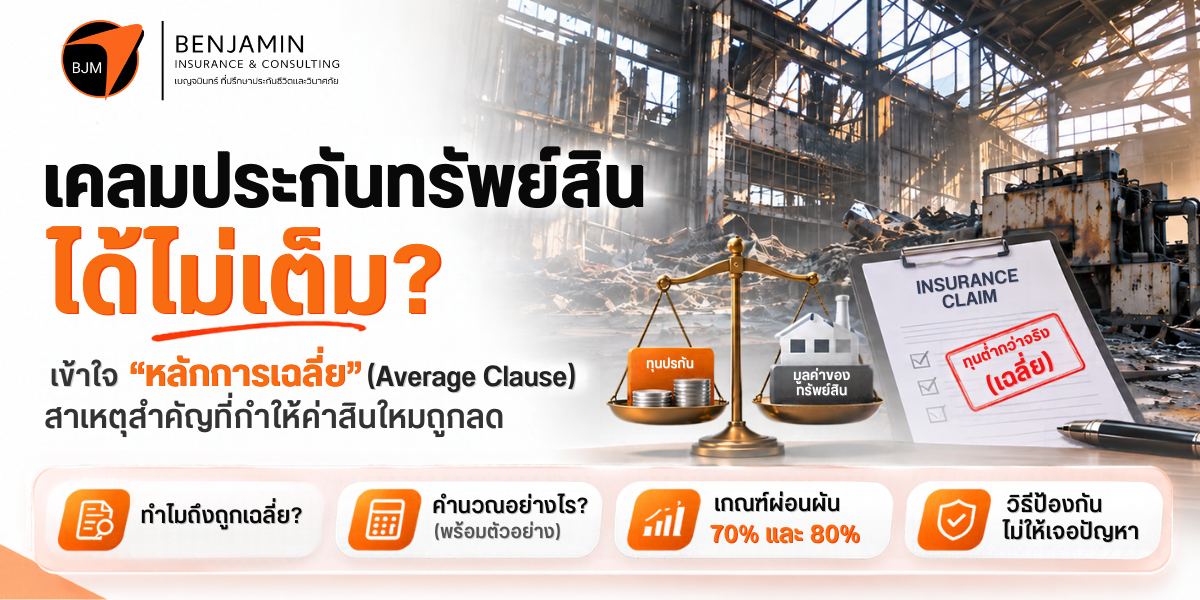
If your property insurance claim was paid less than your loss, even though the loss was well below the sum insured, the most common reason is the average clause. It applies when the sum insured is lower than the actual value of the property at the time of loss.
- The insurer treats you as having "self-insured" the shortfall, and pays only in the proportion sum insured ÷ actual value.
- The comparison is between the sum insured and the value of the property, not between the sum insured and the loss. A small loss can still be averaged.
- A very common cause in Thailand is insurance arranged through a bank, with the sum insured set at the loan or overdraft (OD) limit rather than the property's real value.
- You can prevent it by insuring at replacement value (the cost to rebuild or buy new today), excluding land, and reviewing the figure every year.
What People Search When This Happens
- Why was my insurance claim not paid in full?
- Fire insurance paid less than the damage, even though the sum insured was enough
- What does "average" or "under-insurance" mean on my claim settlement?
- My bank arranged the fire insurance. Why did the claim come up short?
What Is the Average Clause?
Property insurance premiums are based on the sum insured. If you insure only half the value of your property, you have paid for only half the real risk, so the insurer pays claims in the same proportion. The rest is treated as risk you kept yourself.
In short: insure X% of the value, and you are paid X% of the loss.
The basic formula:
Claim paid = Loss × (Sum insured ÷ Actual value of the property at the time of loss)
(The deductible, if any, is applied after this.)
The 70% and 80% Thresholds
Most Thai property policies do not average the moment the sum insured falls a single baht short. They allow a margin.
- Residential fire insurance generally applies averaging when the sum insured is below 70% of the property's value.
- Business property policies, such as commercial fire insurance or Industrial All Risks (IAR), commonly use an 80% average clause.
- Some policies have no margin at all, and average any shortfall.
Above the threshold, the actual loss is paid (up to the sum insured). Below it, the claim is paid proportionally. Always check the exact wording of your own policy.
Example: Insuring at the Overdraft Limit
A company's factory building and machinery have a replacement value of THB 30 million. They secure an overdraft facility of THB 12 million, so the bank arranges fire insurance with a sum insured of 12 million.
A fire causes THB 5 million of damage. The owner expects full payment, since 5 million is well under 12 million. The result:
Claim paid = 5,000,000 × (12 ÷ 30) = THB 2,000,000
The business bears THB 3,000,000 itself.
Comparison at different sums insured (actual value THB 30 million, loss THB 5 million, 80% average clause, deductible ignored):
| Sum insured (THB) | Share of actual value | Averaged? | Insurer pays (THB) | Business bears (THB) |
|---|---|---|---|---|
| 30,000,000 | 100% | No | 5,000,000 | 0 |
| 24,000,000 | 80% | No (exactly at threshold) | 5,000,000 | 0 |
| 20,000,000 | 66.7% | Yes | ประมาณ 3,333,000 | ประมาณ 1,667,000 |
| 12,000,000 (เท่าวงเงิน OD) | 40% | Yes | 2,000,000 | 3,000,000 |
Why Bank-Arranged Insurance Is So Often Affected
Property insurance arranged through a bank exists mainly to protect the bank's collateral. The sum insured therefore often follows what the bank needs to cover:
- The loan or OD limit, which may be far below the value of the buildings, machinery and stock
- The outstanding balance, which falls over time while construction costs keep rising
- The bank's appraisal value, which is not the same as rebuilding cost and often includes land, which is not insured anyway
Many owners assume "the bank set it up, so it must be right" and only discover the average clause after a loss. The reduced claim may also go first to the bank as loss payee.
Averaging Is Applied Item by Item
The average clause is usually applied separately to each item listed in the policy: buildings, machinery, furniture and equipment, and stock.
For example, the building may be fully insured, but stock is insured at THB 5 million while THB 10 million of stock is on site when the fire happens. The stock loss will be cut in half, even if the total sum insured on the policy looks adequate. Businesses with seasonal stock peaks need to watch this closely.
Other Reasons a Claim Is Paid Short
Not every reduced claim is averaging. Also check the settlement for:
- Deductible borne by the insured per claim
- VAT, which insurers usually exclude for VAT-registered businesses that can reclaim input tax
- Depreciation, if the policy pays actual cash value rather than replacement value
- Salvage value, deducted when you keep the damaged items
- Sub-limits, such as a lower limit for natural catastrophes
- Items not covered or not declared in the policy
How to Tell If Your Claim Was Averaged
Look at the claim settlement letter or the loss adjuster's report. Words such as "average," "under-insurance" or "เฉลี่ย", or a line stating the value at the time of loss with a percentage, mean averaging has been applied.
Your Claim Was Averaged. What Can You Do?
The average clause is a policy condition, so it usually cannot be disputed. The numbers used in the calculation can be. The actual value is the denominator of the formula: if it is overstated, your claim is cut more than it should be. Check:
- Ask for the valuation breakdown and the method the adjuster used.
- Check that the valuation matches the policy's basis, for example a replacement-cost value used against a policy that pays depreciated value.
- Check that uninsured items were not counted, such as land, foundations or property not listed in the policy.
- Check that each item was averaged separately and correctly. An adequately insured item should not be averaged because of another.
- Prepare your own evidence of value: construction quotes, machinery invoices, stock records at the date of loss.
- If agreement cannot be reached, you can file a complaint with Thailand's Office of Insurance Commission (OIC hotline 1186).
How to Avoid Being Averaged
- Insure at replacement value, not the loan amount, bank appraisal or book value.
- Exclude land and foundations from the sum insured.
- Set each item's sum insured correctly: building, machinery, equipment and stock must each be adequate.
- Review the sums insured before every renewal, especially after construction costs rise, extensions, new machinery or stock growth.
- If insured through a bank, request an endorsement to increase the sum insured. The bank remains the loss payee.
- To control premium, consider First Loss or Loss Limit cover instead of simply cutting the sum insured. These are designed to avoid averaging within the agreed limit.
Frequently Asked Questions
My loss was below the sum insured. Why wasn't it paid in full? Because averaging compares the sum insured with the total property value, not with the loss. If the sum insured is below the policy's threshold, every loss is reduced proportionally, large or small.
My bank set the fire insurance sum insured at my loan amount. Will I be averaged? If the loan amount is below the property's replacement value by more than the policy's threshold (commonly 70% for homes and 80% for businesses), your claim is likely to be averaged.
Which policies use the average clause? Mainly property policies such as fire insurance, Industrial All Risks (IAR) and Property All Risks. It does not apply to life or health insurance.
Should I insure above the actual value to be safe? No. Non-life insurance pays no more than the actual loss, so over-insuring only adds premium. The right sum insured is close to replacement value.
Can I increase the sum insured mid-term on a bank-arranged policy? Yes, by endorsement with an additional pro-rata premium. Do it before a loss, since the value is measured at the date of loss.
Can a reduced claim be challenged? The clause itself rarely can, but the valuation can. If land, foundations or uninsured property were included, or the valuation does not match the policy's basis, the settlement may be revised upward.
Why Work With Benjamin
Benjamin Insurance & Consulting has served Thai businesses since 1993. Our strength is not just placing policies but standing with clients when a loss happens. Claims reduced by averaging are among the cases we regularly help clients resolve.
- Free sum insured review, including bank-arranged policies, item by item against replacement value
- Cost-effective structure, choosing between full value, First Loss or Loss Limit cover to fit your budget and real risk
- Hands-on claims support from day one, reviewing the adjuster's valuation, preparing evidence and negotiating with the insurer, even if your policy was not placed through us
Claim paid short, or want to check your sums insured before a loss? Line: @benjamin or fill out claim consulting form here\
This article is for general information only and is not an insurance policy or formal quotation. Actual cover and calculation depend on the terms of each policy.
Ready for Benjamin to take care of you?
Let us be your personal risk management team.