
Carrier's Liability Insurance ≠ Cargo Transport Insurance
Why Searching "Transport Insurance" Might Not Get You What You Need
Insurance related to cargo transport can be classified into three types, based on the insured's relationship of responsibility toward the goods.
- The goods owner — buys insurance to protect the value of its own goods in transit.
- The warehousing and shipping management provider — manages the overall transport process and may subcontract the actual physical transport to another carrier.
- The contracted carrier — the party that physically transports the goods, the last link in the chain, and the one ultimately responsible for the goods if damage occurs while in its custody.
"Cargo transport insurance" is a broad term covering all three, and it's the most-searched term in this category — but each group needs a different policy. This article focuses on the third group, contracted carriers, since they carry the most direct liability risk toward a client's goods. The policy that fits this group is carrier's liability insurance.
Carrier's Liability Insurance: Policy Overview
This policy covers a contracted carrier's legal liability for loss or damage to a client's goods while in its custody — from collisions and rollovers to drops during loading, water damage, and fire. Coverage is primarily for domestic routes within Thailand, and many policies also extend to neighboring countries within a specified distance, such as a limited range into Myanmar, Laos, and Cambodia, and a longer range into Malaysia. Operators running cross-border routes should confirm this scope carefully before purchase.
Goods Risk Classification and How It Affects Premiums
The type of goods a carrier is responsible for directly affects the premium rate, since different goods carry different likelihoods and magnitudes of loss. The cargo insurance market commonly classifies goods into several risk groups. A typical classification (with the same starting sum insured of THB 100,000 across groups, to make premiums directly comparable) looks like this:
- Lower-risk goods — clothing, furniture, consumer goods, agricultural products — carry the lowest premiums in the range.
- Fragile or easily-damaged goods — bulk/loose cargo, bottled or canned beverages, ceramics, tiles, machinery and engines under 1,000 kg — a step up in premium.
- Vehicles for resale — new or used cars, new or used motorcycles, agricultural and industrial machinery/vehicles.
- Fresh food and livestock — fresh food and seafood, shrimp, shellfish, crabs, fish, poultry, livestock, fresh produce, ice cream, frozen food — noticeably higher premiums due to fast spoilage risk.
- Liquids and fuel in tanks — fuel, liquids, gas in tanks.
- Cold-chain goods requiring temperature control throughout the route — higher premiums due to dependence on continuous refrigeration equipment.
- Highest-risk fresh produce/food routes (e.g., long-distance or cross-border) — the highest premiums of all the groups.
Even at the same starting sum insured, premiums across these groups can differ by several multiples. Carriers should fully and accurately declare the actual goods they transport at the time of purchase — if an actual loss falls under a risk category that was never declared, it can jeopardize the claim.
Contract Liability Terms: An Often-Overlooked Risk
Beyond the policy itself, a contracted carrier also has a service agreement with each client, which often sets liability terms stricter than or different from the policy's general conditions. For example:
- A fixed compensation price for damaged goods, which can sometimes be set higher than the goods' actual cost or market value, obligating the carrier to pay the contractually agreed price even if it exceeds the real value.
- Branded or sensitive goods, where the contract may require the carrier to compensate at full retail price even if the goods were seized or destroyed.
Carriers should check whether the liability terms in each client contract align with the coverage and limits their carrier's liability policy actually provides. If a contract imposes a heavier obligation than the policy covers, the carrier bears that gap entirely out of pocket.
Deductibles and Sub-Limits
When a loss occurs, two sets of figures in the policy determine the net amount the carrier receives, and they are typically set together in the same conditions table by peril type.
- Deductible (excess) — the portion the carrier must bear before the insurer pays the rest, typically set as a percentage of the loss with a floor, not a flat figure.
- Sub-limit — the maximum amount the insurer will pay for that type of damage per occurrence.
An example table commonly seen in carrier's liability policies, combining both figures by peril (illustrative only):
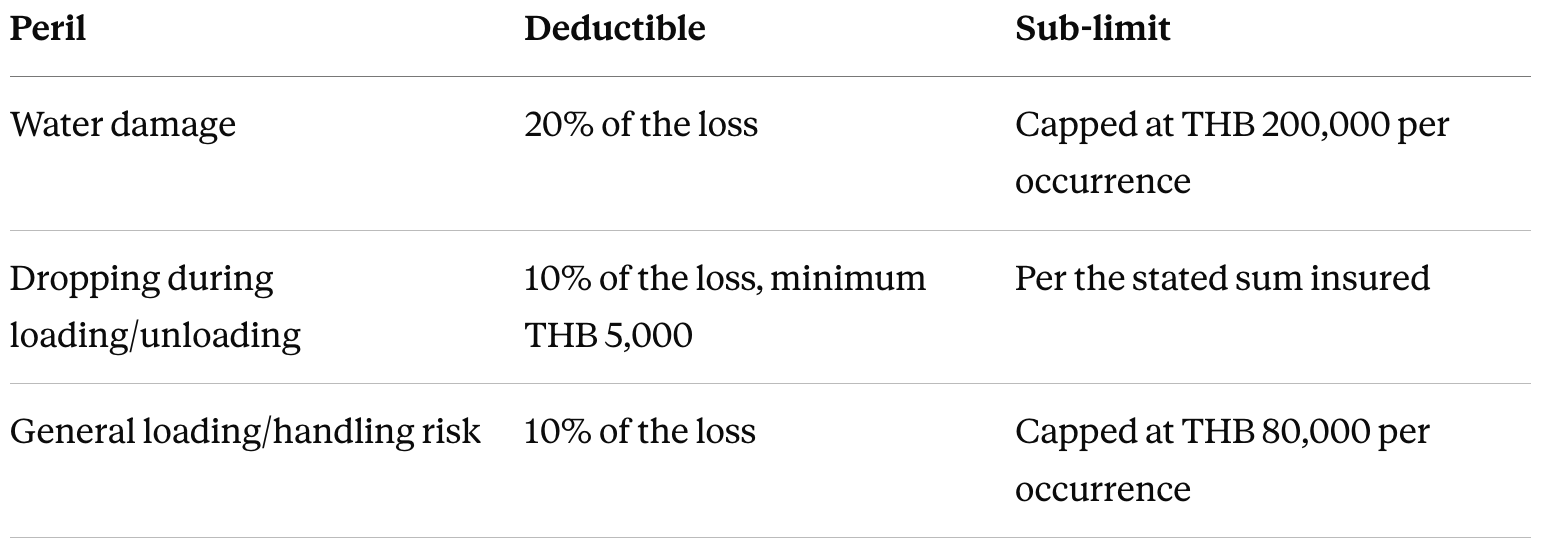
Neither the deductible nor the sub-limit is a single figure for the whole policy — both are broken down by peril type and work together. A carrier that doesn't read this table closely at purchase can easily misjudge its real exposure, especially when an actual loss falls under a peril with both a high deductible percentage and a low sub-limit at the same time.
Managing Goods After a Loss
Once a loss occurs, what determines how large a shortfall the carrier faces isn't just the deductible and sub-limit figures in the policy — it also depends on how the damaged goods are managed afterward: separating damaged goods to prevent further loss, arriving at a fair damage valuation, and disposing of the remaining stock (salvage), which still holds value.
On the salvage side, a high and fast sale means insurers typically deduct that realized value from the net loss — narrowing the shortfall the carrier is left to absorb, whether that's an amount above the sub-limit or an additional sum owed to the client. Conversely, a slow process tends to erode salvage value over time, especially for perishable goods or those with specific safety conditions, and adds hidden costs like storage and repeated handling that widen the carrier's shortfall further.
A Real Case
In one case, a contracted carrier was transporting animal feed from an origin factory to a client's destination factory. Some of the shipment suffered water damage in transit, which fell under the carrier's responsibility per its service agreement. The carrier's liability policy responded to cover its liability toward the client, the goods owner.
The complexity came from valuing the damaged goods, since water-damaged feed carried specific safety conditions (such as a required withdrawal period before further use). This required weighing value across several sales channels — authorized dealer pricing, online retail pricing, and small-lot buyer pricing — to arrive at a fair base value for the claim calculation.
On the salvage side, both the insurer's own surveyor and Benjamin's team independently sourced potential salvage buyers. The surveyor brought in several offers; Benjamin's team used its own buyer network to bring in additional competing offers. The result: the highest offer came from Benjamin's network, exceeding the best offer the insurer's surveyor had sourced.
The outcome was the best achievable market price for the salvage at that time, closed quickly enough to prevent further value loss on a time-sensitive product. The final shortfall the carrier was left to absorb from this incident was narrowed as much as the situation allowed.
Why a Broker That Stays Through Post-Loss Management Matters
Many brokers consider their job done once the policy is sold and the claim is filed. But the stage that actually determines how large a shortfall a carrier is left with usually comes later — during loss valuation and post-loss goods management.
Benjamin stays with the insured through the entire process: advising on which goods categories to declare, aligning client contract liability terms with policy coverage, and setting appropriate deductibles and sub-limits from the moment of purchase, through to using its own salvage buyer network to secure the best possible price when a loss actually occurs. A good cargo insurance claim doesn't end at "the claim was paid" — it ends at "the shortfall the carrier had to bear was as small as it could possibly be."
If your business is contracted to transport goods for clients and you'd like to review whether your current carrier's liability policy covers the goods you actually transport, aligns with your client contracts, and carries appropriate deductibles and sub-limits, Benjamin's team is glad to help.
Ready for Benjamin to take care of you?
Let us be your personal risk management team.