
Car Insurance Classes in Thailand Explained: Type 1, 2+, 2, 3+ and 3 Compared

Every time a motor policy comes up for renewal, the same question returns: should you keep the same class, or step down to something cheaper? Many drivers decide on price alone. Yet what really determines how well you are looked after on the day your car has a problem is the class of cover you choose, not just the premium you pay.
This guide explains how each car insurance class in Thailand differs, what each one covers, and which class fits which type of car and usage, so you can decide based on real protection rather than price alone.
First: compulsory insurance and voluntary insurance are not the same
Many people assume that having compulsory insurance is enough. It is not.
- Compulsory Motor Insurance (por ror bor / พ.ร.บ.) is required by law for every vehicle. It covers bodily injury to people only, including the driver, passengers, and third parties. It does not cover any vehicle, neither yours nor the other party's.
- Voluntary insurance is the cover an owner chooses to add. It comes in five classes: Type 1, 2+, 2, 3+ and 3, which are the focus of this article.
In short: compulsory insurance protects "people," while voluntary insurance protects "vehicles" and your liability for the other party's property.
What each car insurance class covers
Type 1: the most comprehensive cover
Type 1 offers the widest protection and is the only class that repairs your own car even when there is no identifiable other party, such as hitting a pole or tree, running off the road, or a scrape where no counterparty can be found.
It covers:
- Third-party liability for injury, loss of life, and property
- Repairs to your own car, with or without a counterparty
- Fire, theft, and generally flood
Best for: new cars or vehicles that still hold high value (usually up to around seven years old, depending on the insurer), drivers in higher-risk city conditions, or newer drivers who want maximum peace of mind.
Type 2+: the balance between cover and price
Type 2+ offers protection close to Type 1, with one important condition: repairs to your own car are covered only when you collide with a land vehicle and the counterparty can be identified. Single-vehicle accidents with no counterparty are not covered.
It covers:
- Third-party liability for injury, loss of life, and property
- Repairs to your own car, only in a vehicle-to-vehicle collision with a counterparty
- Fire, theft, and flood (on some policies)
Best for: cars that are a few years old, and experienced drivers who are confident their risk of a single-vehicle accident is low but still want protection against fire and theft.
Type 2: fire and theft, but no repairs to your own car
Type 2 is uncommon today. It covers fire and theft, but does not cover repairs to your own car in any situation, whether or not there is a counterparty.
It covers:
- Third-party liability for injury, loss of life, and property
- Fire and theft
- No repairs to your own car
Best for: niche cases where the main concern is theft or fire, and the owner is not worried about repairing their own vehicle.
Type 3+: affordable, but still repairs your car when there is a counterparty
Type 3+ differs from Type 2+ in only one way: it does not cover fire, theft, or flood. It still repairs your own car in a vehicle-to-vehicle collision with a counterparty, which keeps the premium noticeably lower.
It covers:
- Third-party liability for injury, loss of life, and property
- Repairs to your own car, only in a vehicle-to-vehicle collision with a counterparty
- No fire, theft, or flood cover
Best for: older cars, careful drivers, and lower-mileage usage where value for money in a limited budget matters.
Type 3: third-party cover only, the lowest premium
Type 3 is the most basic voluntary class. It covers third-party damage only, for injury, loss of life, and property, but does nothing for your own car.
Best for: older cars with low remaining value, light usage, or drivers who simply want the cheapest third-party protection.
Comparison table: Type 1, 2+, 2, 3+, 3
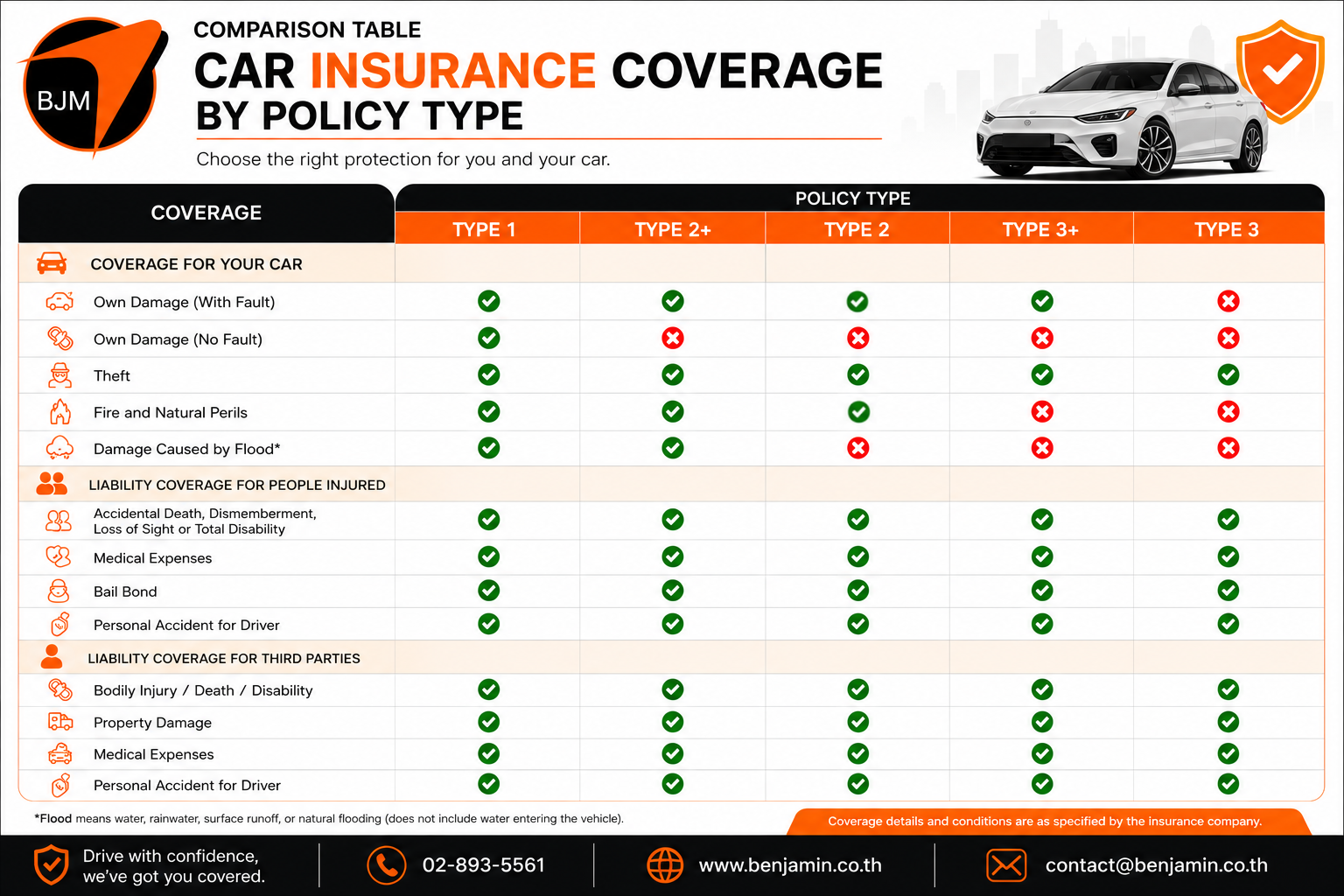
The distinctions people most often confuse
- Type 2+ vs 3+: the only difference is fire, theft, and flood. Type 2+ covers them; Type 3+ does not.
- Type 2 vs 3+: Type 2 covers fire and theft but does not repair your car; Type 3+ repairs your car when there is a counterparty but does not cover fire or theft.
So which class should you choose?
There is no single right answer for everyone, but these three factors will guide you.
- Age and value of the car: a newer, higher-value car usually justifies Type 1, because repairs are costly and single-vehicle accidents are covered. For older cars, Type 2+ or 3+ is often better value.
- Driving experience and habits: newer drivers or those in higher-risk areas benefit from broader cover. Careful, low-mileage drivers can often step down a class to save on premium.
- Budget and risk tolerance: consider how much of a repair bill you could comfortably pay yourself. The gap between the premium and the risk you carry alone is the trade-off to weigh.
For commercial or fleet vehicles, such as taxis, delivery vehicles, or EV fleets, the class decision is more complex. You have to weigh the total cost across the whole fleet, how often incidents occur, and the operational impact when a vehicle is off the road for repair. Here, a broker who understands your business can design cover that fits far better than choosing on price alone.
Choosing the right class is only half the equation
What many drivers discover only when an incident happens is that holding the correct class does not guarantee a smooth claim. The questions that follow are usually the ones a policy does not answer clearly: dealer repair or independent garage, cash settlement or repair, whether the damage assessment is fair, and what to do if the insurer disputes part of the liability.
This is exactly what Benjamin Insurance & Consulting has focused on since 1993. We are not simply a seller of policies. We are an advisor who stays beside you through the entire claim process, from choosing the class and sum insured that match how you actually use the vehicle, to negotiating and following up on claims so you receive a fair settlement. Our strength is end-to-end problem solving and claim support, which is what makes the biggest difference on the day you actually need your insurance.
If you are unsure which class to renew into, or you manage a business fleet, the Benjamin team is glad to advise and design cover built around your needs.
Talk to Benjamin's claim specialists at contact@benjamin.co.th or drop your inquiry here
Frequently asked questions
Do I need Type 1 for every car?
No. Type 1 suits new or high-value cars that need maximum protection. For older cars, Type 2+ or 3+ can offer better value relative to the premium.
What is the difference between Type 2+ and 3+?
Only fire, theft, and flood. Type 2+ covers them; Type 3+ does not. Repairs to your car when there is a counterparty are covered the same way in both classes.
If I already have compulsory insurance, do I still need voluntary insurance?
Compulsory insurance covers bodily injury to people only, not your vehicle or property. To cover damage to your car and liability for the other party's property, you should add voluntary insurance.
Do Type 2+ and 3+ cover single-vehicle accidents?
No. Both repair your car only in a collision with a land vehicle where the counterparty can be identified. For single-vehicle, no-counterparty cover, you need Type 1.
Which class should a business fleet choose?
It depends on usage type, vehicle age, and incident frequency. Having a broker analyse the total cost and design the cover helps you land on the right plan while keeping the budget under control.
Ready for Benjamin to take care of you?
Let us be your personal risk management team.